
Import databases · ecoinvent
Import ecoinvent into VoLCA
Load your ecoinvent EcoSpold 2 files to search activities, inspect exchanges, trace supply chains, and calculate impacts with a compatible LCIA method. Use the same imported database from the browser interface, Python, CLI, HTTP API, or MCP.
Bring your own ecoinvent license and files. VoLCA does not provide or redistribute the database.
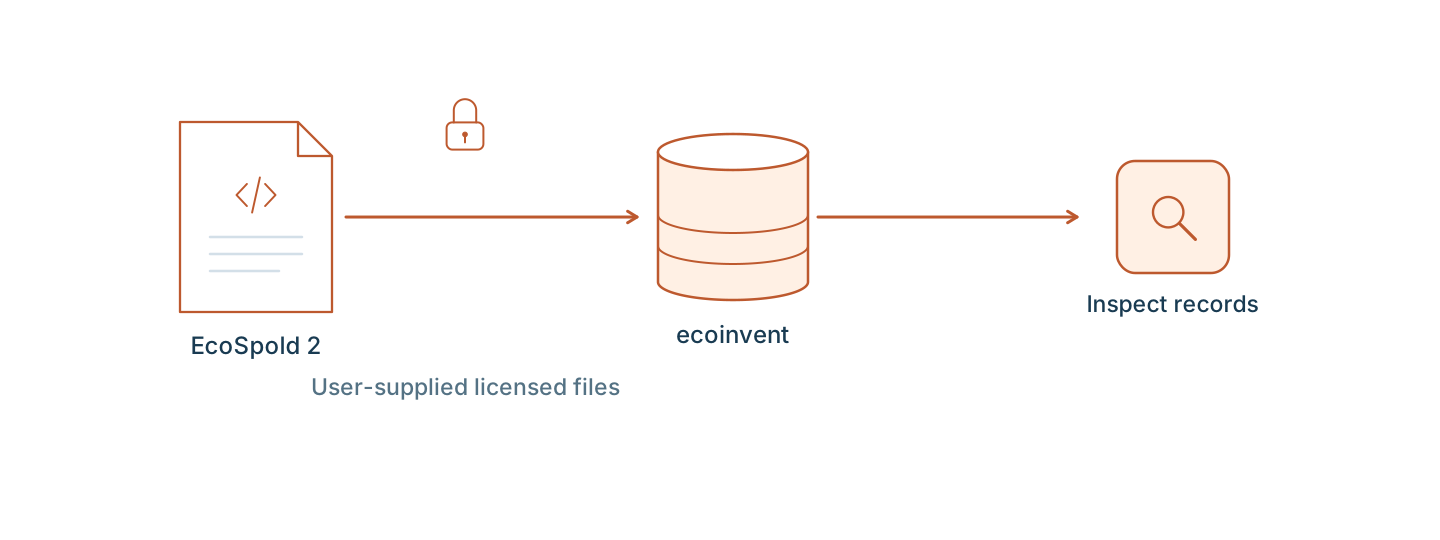
Before importing: choose your ecoinvent files
Download the EcoSpold 2 activity datasets for your chosen ecoinvent version and system model from ecoinvent.org, under your own license. Use the collection of .spold datasets, not the cumulative LCIA results spreadsheet. Keep the version and model together throughout your workflow.
You need a running, writable VoLCA engine. Choose how to run VoLCA, then use the CLI or HTTP API below against that engine. Keep licensed files on an instance whose access controls and use fit your license.
How to import ecoinvent: upload, then load
Once you have an EcoSpold 2 export, the path is the same as any other database: upload stages the archive, loading makes it queryable.
CLI
1. Upload your EcoSpold 2 archive
volca --config volca.toml database upload /data/ecoinvent-3.10.7z \
  --name "ecoinvent"
Upload an archive (ZIP, 7z, tar.gz, tar.xz) of .spold datasets to a running, writable engine. A directory can instead be referenced in a local engine configuration.
HTTP API
2. Load the ecoinvent database
curl -X POST http://localhost:8080/api/v1/db/ecoinvent/loadUpload alone does not load a database. Load it with this endpoint, or set load = true in its configuration entry to load at startup.
The examples assume a local engine configured through volca.toml and reachable at http://localhost:8080. Use your own archive path, server address, and authentication settings. For a protected engine, authenticate the HTTP request as described in the HTTP API guide.
3. Inspect your imported ecoinvent database
Find and inspect an activity
Check that ecoinvent is loaded in your instance, then search for a familiar activity, such as an electricity market. Open it and check its geography, reference product, unit, direct inputs, resources, and emissions. Follow supplier links to inspect the upstream supply chain.
Calculate a first impact result
Load an LCIA method separately, check its flow mapping, and calculate an impact for the selected activity. Match the database version, system model, method, category, and reference amount before comparing with a published result.
ecoinvent versions with published calculation comparisons
The v0.18.0 measurements include ecoinvent 3.8 cut-off, ecoinvent 3.9.1 cut-off, ecoinvent 3.10 cut-off, ecoinvent 3.10.1 cut-off, ecoinvent 3.11 cut-off, ecoinvent 3.12 cut-off. They compare VoLCA calculations with results published by ecoinvent, using the same inventory data and the publisher's impact factors.
ecoinvent 3.12 cut-off: EF v3.1, climate change
24,754 activities compared on 2026-11-14. 0 fall outside the 1% agreement band. This comparison concerns this database, method and category, not every possible ecoinvent calculation.
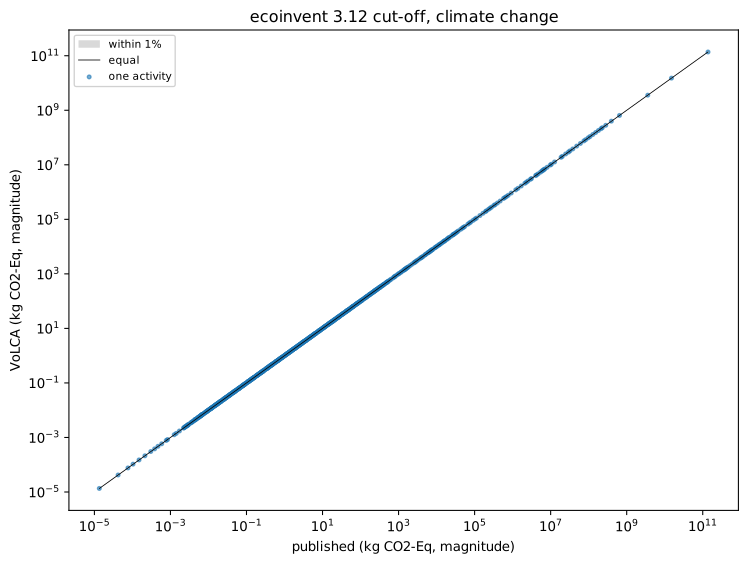
These measurements cover cut-off databases. Do not extrapolate them to APOS or Consequential, or to unmeasured versions and impact categories. The full panel includes disagreements and unavailable comparisons.
Cross-linking a foreground database
A database such as Agribalyse or your own foreground data commonly leaves some suppliers unresolved on its own. Name ecoinvent as a dependency so those suppliers resolve against it:
[[databases]]
name = "ecoinvent"
path = "/data/ecoinvent-3.10"
load = true

[[databases]]
name = "my-foreground"
path = "/data/my-foreground.csv"
load = true
depends = ["ecoinvent"]What EcoSpold 2 import gives you
Loading .spold datasets builds activities, reference products, technosphere and biosphere exchanges, classifications, and supplier links into searchable, computable structures. See the EcoSpold 2 format page for the full list of accepted files and imported data.
Verify before you trust the result
A supported file format is not proof of a complete or correct import. Before treating an ecoinvent import as calculation evidence:
- Compare the loaded activity count against the release notes for the exact version and system model you imported.
- Search for a process you already know, such as a national electricity mix, and confirm its reference product and unit are as expected.
- Read any supplier-linking warnings the load reports rather than ignoring them; each one names an unresolved reference.
- Import an LCIA method, such as an EF 3.1 collection, as a separate step and audit its flow mapping against ecoinvent before trusting characterized results.
Frequently asked questions
Does VoLCA include ecoinvent?
No. ecoinvent is licensed data; you need your own copy and license from ecoinvent.org. VoLCA reads the EcoSpold 2 format ecoinvent ships in, it does not provide or redistribute the database.
Which ecoinvent versions and system models does VoLCA read?
VoLCA detects EcoSpold 2 from the .spold datasets themselves, not from a specific ecoinvent release. Version and system model, such as Cut-off, APOS, or Consequential, are choices you make at ecoinvent's own site. Verify the loaded activity count and a known process against your chosen release after import.
Does importing ecoinvent prove it is compatible with an LCIA method?
No. A successful import establishes that the data loaded, not that a chosen method's flows map onto it. Audit flow mapping and validate the method separately.
Can I link ecoinvent to my own foreground database?
Yes. Set depends on the foreground database's configuration entry, naming ecoinvent, so its unresolved suppliers are looked up there.
Where do I get ecoinvent?
From ecoinvent.org, the database's own publisher, under your own license.