
Database export · EcoSpold 1
Export EcoSpold 1 XML databases
Save a loaded LCA database as one EcoSpold 1 XML file for a workflow that needs the older inventory format. Choose this destination when your next workflow needs EcoSpold 1.
What is EcoSpold 1?
EcoSpold 1 is the earlier XML inventory format used by ecoinvent versions 1 and 2. One document can contain multiple process datasets with products, inputs, emissions, resources, units, and categories.
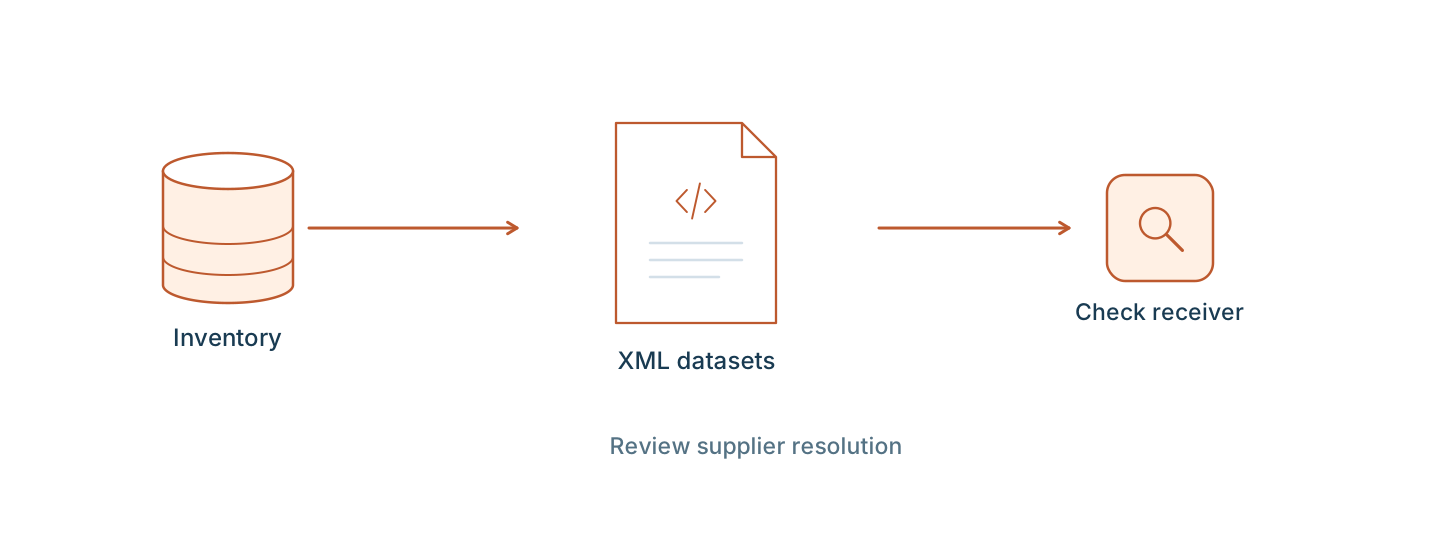
What you get
One XML file with process datasets under an ecoSpold root. This is not a ZIP of EcoSpold 2 .spold files.
Export value: ecospold1
Start with a loaded database
Import and load your source database on a running VoLCA server first. Uploading a file alone is not enough. Replace my-database with the loaded database name.
Review load warnings and supplier dependencies before exporting. Only export and share data your license allows you to use.
Choose an import path →Save the database to a file
These CLI and Python examples address your running server. Smoke checks used VoLCA v0.12.0 and pyvolca 0.11.0 with a synthetic single-product database. All five CLI file-generation operations completed. openpyxl exposed an OOXML manifest defect in the v0.12.0 Brightway file; merged PR #396 adds the missing package parts, and the resulting workbook opened successfully with openpyxl. Other formats were not import-tested in receiving applications. File generation does not establish metadata fidelity, supplier-link fidelity, or acceptance by another application.
CLI
volca --config volca.toml --url http://localhost:8080 database export my-database \
  --format ecospold1 --out database-ecospold1.xml
Use your existing volca.toml configuration and credentials. Replace the local URL with your server address.
Python
from volca import Client

client = Client("http://localhost:8080")
client.export_to_file("ecospold1", "database-ecospold1.xml",
                      db_name="my-database")
Install pyvolca, replace the local server URL, and supply credentials when required. Choose a new output filename to avoid replacing an existing file.
What the writer carries forward
The writer carries flow names, exchange amounts and roles, units, categories, and available process metadata from the loaded database.
Exports are written from VoLCA's loaded data model. They are not copies of the original source files.
Limits to check before using the file
The writer assigns canonical dataset and exchange numbers. It does not preserve the numbering or arbitrary source UUIDs of the original file. Linked technosphere inputs require supplier resolution when loaded again. Avoided products are represented as negative inputs, so their original role label changes.
Review export warnings and errors. A file being written does not establish target-software compatibility, successful supplier linking, or equivalent LCIA results. Import and verify a compatible LCIA method separately.
Read the writer source →A measured Agribalyse export example
The historical VoLCA v0.9.1 run exported Agribalyse to ILCD, EcoSpold 1, and EcoSpold 2 and checked file structure, counts, and checksums. Its files were not re-imported into target software, and LCIA equivalence was not established. Those measurements do not describe a current-release test.
Read the measured example and its limits →Frequently asked questions
Should I choose EcoSpold 1 or EcoSpold 2?
Choose the version requested by the receiving workflow. EcoSpold 1 produces one XML document with numbered datasets; EcoSpold 2 produces a ZIP of .spold datasets with UUID-based identifiers. Renaming the file does not convert between them.